
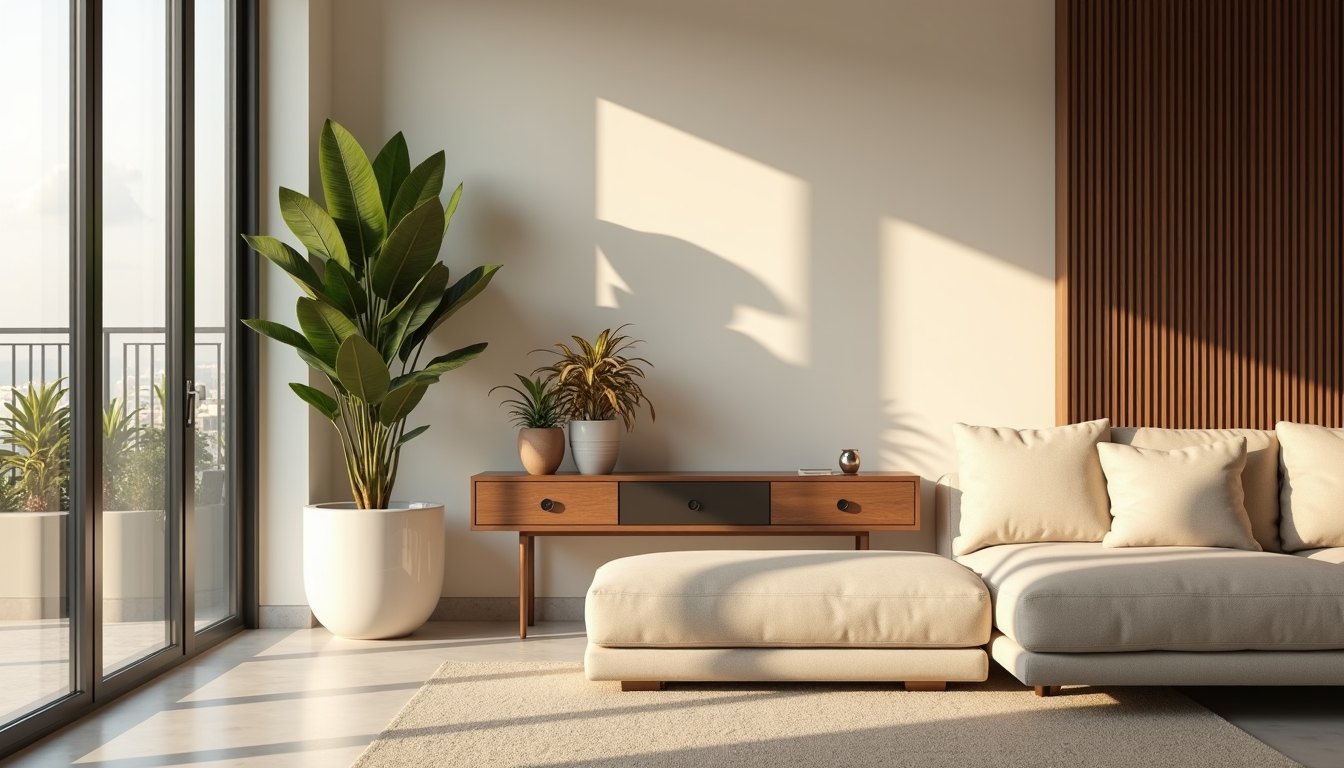
Air-Purifying Plants: What Actually Works in a Dubai Home
Air purifying plants don't purify your air. Not enough to matter, not inside a sealed, air-conditioned Dubai apartment, and the science behind that phrase was overturned years ago. That's an uncomfortable thing for a flower and plant shop to admit, but it's true, so we're saying it before you spend money for the wrong reason.
In 1989, NASA ran a study that seeded three decades of marketing around air purifying indoor plants. In 2020, researchers at Drexel University went back through thirty years of the underlying data and found the effect is far too small to matter in a real room. We'll walk through both properly, then make the honest case for keeping plants anyway, because there is one, and it's better than the myth. Upscale & Posh is a luxury flower and plant delivery service in Dubai, and we'd rather you buy a snake plant for the right reason than the wrong one.

What the NASA study actually tested
The 1989 NASA study tested sealed spacecraft chambers the size of a large suitcase, not living rooms. B.C. Wolverton of NASA's John C. Stennis Space Center published A Study of Interior Landscape Plants for Indoor Air Pollution Abatement in July 1989 (report NASA-TM-108061), with a plant list chosen jointly with the Associated Landscape Contractors of America.
Plants went into sealed Plexiglas chambers of 0.868 and 0.694 cubic metres, injected with a single chemical, then measured after about 21 to 22 hours. Three volatile organic compounds were tested: benzene, trichloroethylene and formaldehyde.
None of this was about homes. NASA was thinking about closed spacecraft environments, tracing back to Skylab, where the agency had identified 107 volatile organic compounds circulating in the cabin air. Wolverton put the ambition plainly: "If man is to move into closed environments, on Earth or in space, he must take along nature's life support system."
The detail lost in three decades of retellings matters most: soil and root microorganisms, not leaves, appeared to be the main removal pathway. In some tests, defoliated plants with no leaves at all removed more benzene than plants with full foliage. That's a result about soil biology, not about how your living room behaves.
What changed in 2020
In 2020, two researchers at Drexel University showed the NASA finding doesn't scale to a real room, however many plants you own. Bryan E. Cummings and Michael S. Waring published Potted plants do not improve indoor air quality: a review and analysis of reported VOC removal efficiencies in the Journal of Exposure Science & Environmental Epidemiology, working through every chamber study published over the previous 30 years.
They converted 196 experimental results from 12 published studies into Clean Air Delivery Rate, or CADR, the same metric used to rate mechanical air purifiers. The median single potted plant scored a CADR of 0.023 cubic metres of air per hour. A standard standalone air purifier moves around 100 cubic metres per hour. Not a close contest.
To match the air exchange a typical building already achieves on its own, Cummings and Waring calculated you'd need somewhere between 10 and 1,000 plants per square metre of floor space. Even at the low end, nobody is fitting that many pots into a Dubai apartment.
Waring, an Associate Professor of Architectural and Environmental Engineering at Drexel, put it plainly: "This has been a common misconception for some time. Plants are great, but they don't actually clean indoor air quickly enough to have an effect on the air quality of your home or office environment." He added: "This is certainly an example of how scientific findings can be misleading or misinterpreted over time."
Why Dubai makes this harder than most places
Dubai's air quality problem is real, and it's bigger than any windowsill of houseplants could fix. Human Rights Watch reported in December 2023, citing 2019 World Bank data, that mean annual PM2.5 exposure in the UAE exceeds 40 micrograms per cubic metre, more than eight times the World Health Organization's annual guideline of 5. In September 2023, average daily PM10 across 30 UAE government ground monitoring stations hit 125 micrograms per cubic metre, almost three times the WHO's 24-hour guideline.
Indoors isn't automatically safer. A peer-reviewed 2021 study of residential buildings in Dubai, published in the journal Buildings, found volatile organic compound and formaldehyde concentrations in showhouses and new townhouses running at roughly ten times outdoor levels: new paint, adhesives and finishes off-gassing into rooms sealed for most of the year. Air conditioning adds to it. Dehumidifying is a side effect of cooling, so a Dubai home running recirculated AC most of the year typically sits well below comfortable indoor humidity, whatever's happening outside.
So here's the honest conclusion most plant-shop blog posts won't give you: if air quality is what you're solving for, the tools are ventilation and a proper HEPA purifier. Neither is a houseplant, and no number of houseplants replaces either. That's a reason to buy plants for what they're actually good for, not a reason to skip them. For a broader look at what grows well here, see our 2026 guide to indoor plants that thrive in Dubai.
What indoor plants genuinely do
Plants don't clean your air, but they measurably change how you feel in a room. Virginia Lohr at Washington State University ran a 1996 study, published in the Journal of Environmental Horticulture, on 96 participants completing a stressful reaction-time task in a windowless computer lab. With plants present, reaction times were 12% faster. Blood pressure still rose during the task in both groups; plants don't stop that. But it rose by only 2 points with plants present versus 4 points without, so the plants blunted the spike rather than erasing it. As Lohr put it: "By somehow causing us to be more relaxed, plants help us be more productive and focused."
That finding isn't a one-off. Nieuwenhuis and colleagues ran three field experiments in real commercial offices in 2014, published in the Journal of Experimental Psychology: Applied, and found that adding plants to a bare, lean office raised productivity by 15%. Actual offices, not a lab simulation.
There's a genuine, if modest, environmental effect too. Researchers Gubb, Blanusa, Griffiths and Pfrang, with the Royal Horticultural Society and University of Birmingham, found in a 2018 RHS study that houseplants measurably affect carbon dioxide and relative humidity indoors, though the effect depends on light and species, and at typical indoor light levels carbon dioxide removal was low. Humidity matters most in Dubai: air conditioning strips moisture from a room, and a transpiring plant puts some back. It's an honest reason to keep something living on the windowsill, a smaller and truer pitch than "purifies your air".
Search for indoor plants for oxygen and you'll find the same tangle of half-truths. Plants do produce oxygen through photosynthesis, that part is real, but the volume any houseplant produces is tiny next to the air already moving through a room. The best indoor plants for oxygen and general wellbeing are still the ZZ plant and snake plant: the ones you'll actually keep alive.
Plants chosen for Dubai, not a catalogue
Our plant gifts are selected for what actually survives a low-light, air-conditioned apartment, delivered across Dubai the same day.
Shop Plant GiftsThe seven plants that actually survive a Dubai apartment
For a Dubai apartment, buy plants bred for shade and drought, not humidity and rainforest floor. The ZZ plant and snake plant are the strongest, most low maintenance indoor plants for a low-light, air-conditioned home: both treat dry, recirculated air as normal. Pothos and spider plant are solid second choices. Bamboo palm, peace lily and rubber plant will survive, but need humidity support and distance from AC airflow.
| Plant | Light | Water | AC & dry air | Pet safety |
|---|---|---|---|---|
| Snake plant | Full sun to deep shade | Let soil dry out fully between waterings | Excellent, semi-arid adapted | Toxic to cats and dogs |
| ZZ plant | Extremely shade tolerant | Only when fully dry, roughly every 2–4 weeks | Excellent, East African origin, built for dry air | Toxic to cats and dogs |
| Golden pothos | Low light tolerated, faster in bright indirect | Every 7–14 days | Good, adaptable | Toxic to cats and dogs |
| Spider plant | Bright indirect to moderate | Forgiving, adaptable schedule | Good, adaptable | Only mildly toxic, one of the safer common houseplants |
| Bamboo palm | Low to moderate light | Keep evenly moist | Weak, prefers higher humidity, expect brown tips without help | Non-toxic, genuinely pet safe |
| Peace lily | Bright indirect preferred | Keep moist | Poor, wants 50–60% humidity, sensitive to AC vents | Toxic to cats and dogs, rarely severe |
| Rubber plant | Bright indirect | Let soil dry 1–2 inches down | Weak, sensitive to drafts, AC vents and temperature swings | Toxic to cats and dogs |
Snake plant (Dracaena trifasciata) is close to unkillable: full sun to deep shade, water only once the soil is fully dry, and semi-arid origins mean dry AC air suits it rather than merely being tolerated. It's toxic to cats and dogs, so keep it out of reach.

ZZ plant (Zamioculcas zamiifolia) tolerates rooms most plants give up in, wants water only every two to four weeks once established, and its East African origins make dry air the default rather than a challenge. Also toxic to cats and dogs.

Golden pothos (Epipremnum aureum) grows in low light and faster in bright indirect, watered every one to two weeks. Genuinely adaptable rather than fussy, and a reliable second choice. Also toxic to cats and dogs.

Spider plant (Chlorophytum comosum) wants bright indirect to moderate light and forgives an inconsistent watering schedule. The good news for pet owners: it's only mildly toxic, one of the safer common houseplants here.
Bamboo palm (Chamaedorea seifrizii) copes with low to moderate light and even moisture, but prefers higher humidity than a Dubai living room usually offers, so expect brown tips without help such as grouping plants together. It's the one genuinely non-toxic plant here, worth the extra care for pet owners.
Peace lily (Spathiphyllum) prefers bright indirect light, constant moisture and 50–60% humidity, a big ask indoors here. It's sensitive to cold drafts and AC vents, a poor match for airflow-heavy rooms. Toxic to cats and dogs, rarely severely.
Rubber plant (Ficus elastica) wants bright indirect light and soil dried an inch or two down before its next drink, but it's sensitive to drafts, AC vents and temperature swings, so placement matters. The ASPCA classifies Ficus species, including the closely related weeping fig, as toxic to cats and dogs.
Browse our plant gifts collection for arrangements built around species like these, chosen for Dubai conditions rather than a generic international list.
Where to put them in a Dubai apartment
Placement decides whether indoor plants in Dubai thrive or slowly die, more than almost any other factor. Follow this order to avoid the mistakes that kill most indoor plants here.
- Keep every plant at least a metre from a direct AC vent or return. Cold, fast-moving, dry air blowing straight onto leaves is the single biggest cause of brown tips and dropped foliage in air-conditioned homes.
- Match the plant to your actual light, not the light you wish you had. A north-facing room that reads as bright can still be too dim for a peace lily, while unfiltered west-facing glass can scorch a rubber plant by mid-afternoon.
- Check soil moisture by touch before watering, not on a fixed schedule. Recirculated AC dries the top inch of soil faster than it would outdoors, so the surface can feel dry while the roots underneath are still wet.
- Group humidity-loving species such as bamboo palm and peace lily together and away from vents, so they raise the local humidity around each other. It's a small effect, but it shows in the leaves.
- Rotate pots a quarter turn every week or two if they sit near a single light source, or growth will pull towards the light and leave the plant lopsided.
For a room-by-room breakdown of where different species do best, see our guide to the ideal areas to place houseplants. Orchids need heavier humidity than anything on this list, and our guide to how to care for orchids in Dubai covers what that takes.

Prefer something in bloom
Hand-tied by our florists each morning and delivered across Dubai the same day, in season and arranged to last.
Shop the Signature CollectionFrequently asked questions
Do air-purifying plants actually work?
Not for cleaning your air at a scale that matters: a 2020 re-analysis by Drexel University researchers of thirty years of chamber studies found the median houseplant removes airborne volatile organic compounds at roughly 0.023 cubic metres of air per hour, next to nothing compared with a mechanical air purifier moving around 100 cubic metres per hour. Plants earn their place for other reasons.
What is the best air-purifying plant?
There isn't a truly air-purifying houseplant, since none clean air fast enough to matter, but for a Dubai home the ZZ plant and snake plant are the strongest all-round choices, because both are shade-tolerant, drought-adapted species that treat dry, air-conditioned air as normal rather than a stress most popular houseplants can't handle.
Which indoor plants need the least maintenance in Dubai?
The ZZ plant and snake plant need the least maintenance by a clear margin, because both tolerate low light, need watering only every two to four weeks once established, and come from semi-arid regions, which means recirculated air-conditioned air suits them rather than working against them the way it does with tropical species like peace lilies.
Are air-purifying plants safe for cats and dogs?
Most of the popular ones aren't: snake plant, ZZ plant, golden pothos, peace lily and rubber plant are all toxic to cats and dogs to varying degrees and need to be kept well out of reach, while bamboo palm is genuinely non-toxic and spider plant is only mildly toxic, making them the two safest choices here for pet households.
How many plants do I need to clean the air in a room?
For any measurable effect on air quality, more than any home could realistically hold: researchers at Drexel University put the figure at somewhere between 10 and 1,000 plants per square metre of floor space, just to match the air exchange a typical building already achieves on its own without any help from plants at all. For wellbeing, a few placed well do more good.
Do plants produce oxygen at night?
Most plants respire rather than photosynthesise once it's dark, taking in a small amount of oxygen and releasing carbon dioxide instead, which is the reverse of what happens during the day, though the effect on the air in an average bedroom is far too small to notice either way. Not a reason to avoid them in a bedroom.
None of this makes plants a lesser purchase; it makes them an honest one. Buy a HEPA purifier if air quality is the problem you're solving. Buy a snake plant or a well-placed pothos because a room with something alive in it feels different, and Dubai's dry, air-conditioned homes can use the humidity. That's a smaller claim than "cleans your air", and it happens to be true. Explore our signature collection or our full range of bouquets if flowers suit the room better.

Leave a comment
This site is protected by hCaptcha and the hCaptcha Privacy Policy and Terms of Service apply.