
Marigold Flower Meaning: Symbolism, Colours & Why Dubai Loves Them

Published 31 August 2026 · Last updated 31 August 2026 · By the Upscale & Posh floral team, Dubai
The marigold flower symbolises the sun, devotion, prosperity and remembrance, which is why it appears at both the happiest and the most solemn moments in human life. It is the flower of temple offerings and wedding garlands, and also the flower laid out for the dead. Few blooms carry that much range.
In Dubai, the marigold is not a novelty import. Walk through Meena Bazaar on the morning before a wedding, or past a villa doorway in the week before Diwali, and you will see it everywhere, strung into garlands by hand. This guide covers what the marigold means, what each colour represents, how it is used across South Asian tradition, and how to keep it alive in a Gulf climate. Upscale & Posh is Dubai's luxury flower delivery service, and the marigold is one of the few flowers we get asked about by name.
What Does the Marigold Flower Mean?
The marigold means devotion, prosperity and the enduring warmth of the sun. In South Asian tradition it is auspicious, offered to deities and hung at doorways to invite good fortune. In much of Europe and the Americas it carries the opposite weight, standing for grief and remembrance. Same flower, two very different readings.
Botanically it belongs to the genus Tagetes, a group of daisy-family plants native to the Americas. Spanish and Portuguese traders carried it east in the sixteenth century, and within a few generations it had been absorbed so completely into Indian ritual life that most people assume it was always there. That journey is the reason its symbolism splits so sharply along geographic lines.
The marigold at a glance:
- The sun and light — its shape and colour read as a small, contained sun
- Devotion and worship — the standard offering flower across Hindu temple practice
- Prosperity and auspiciousness — gold-toned, associated with Lakshmi and new beginnings
- Remembrance and grief — in Mexico and Victorian Europe, a flower of the dead
- Resilience — it thrives in heat and poor soil where softer flowers fail
Marigold Colour Meanings
Marigold colour changes the message significantly, more than it does in most flowers. Orange and gold carry celebration and devotion. Cream and maroon shift the tone towards restraint and remembrance. If you are choosing for a specific occasion, the shade matters as much as the flower.
| Colour | What It Symbolises | Best Occasion to Gift |
|---|---|---|
| Deep orange | Devotion, energy, the strength of the sun. The classic temple and garland shade. | Diwali, weddings, temple offerings |
| Golden yellow | Prosperity, wealth, divine favour. The shade most associated with Lakshmi. | New business openings, housewarmings |
| Bright yellow | Optimism, friendship, fresh starts. Lighter and less formal than deep gold. | Congratulations, graduations, thank you |
| Red-tipped / bicolour | Passion held alongside devotion. Visually the richest of the family. | Weddings, anniversaries, engagements |
| Cream / white | Purity, peace, quiet respect. Rare and read as understated. | Reflective occasions, minimal styling |
| Maroon / burgundy | Depth, memory, grounded emotion. The most sombre of the marigolds. | Remembrance, autumnal arrangements |

If colour symbolism is the part that interests you, our guide to what every rose colour says and when to send them in Dubai covers the same ground for the flower most people reach for first.
The Marigold in South Asian Culture: Genda Phool, Garlands and Ceremony
In South Asian tradition the marigold is the default ceremonial flower, known across North India as genda phool. It is offered at temples, strung into garlands for weddings, hung across doorways at Diwali, and scattered at almost every threshold moment in a family's life. No other flower does as much work.
There is a practical reason it won that role, and it is worth understanding. The marigold head is dense and holds its shape when threaded, so a garland strung at dawn still looks structured by evening. Its colour sits exactly in the gold-to-sun range that reads as auspicious and is associated with Lakshmi. It carries a sharp green scent strong enough to hold its own against incense smoke rather than disappear beneath it. And it survives heat that would collapse a rose in an hour. Ritual chose the marigold because the marigold could take it.

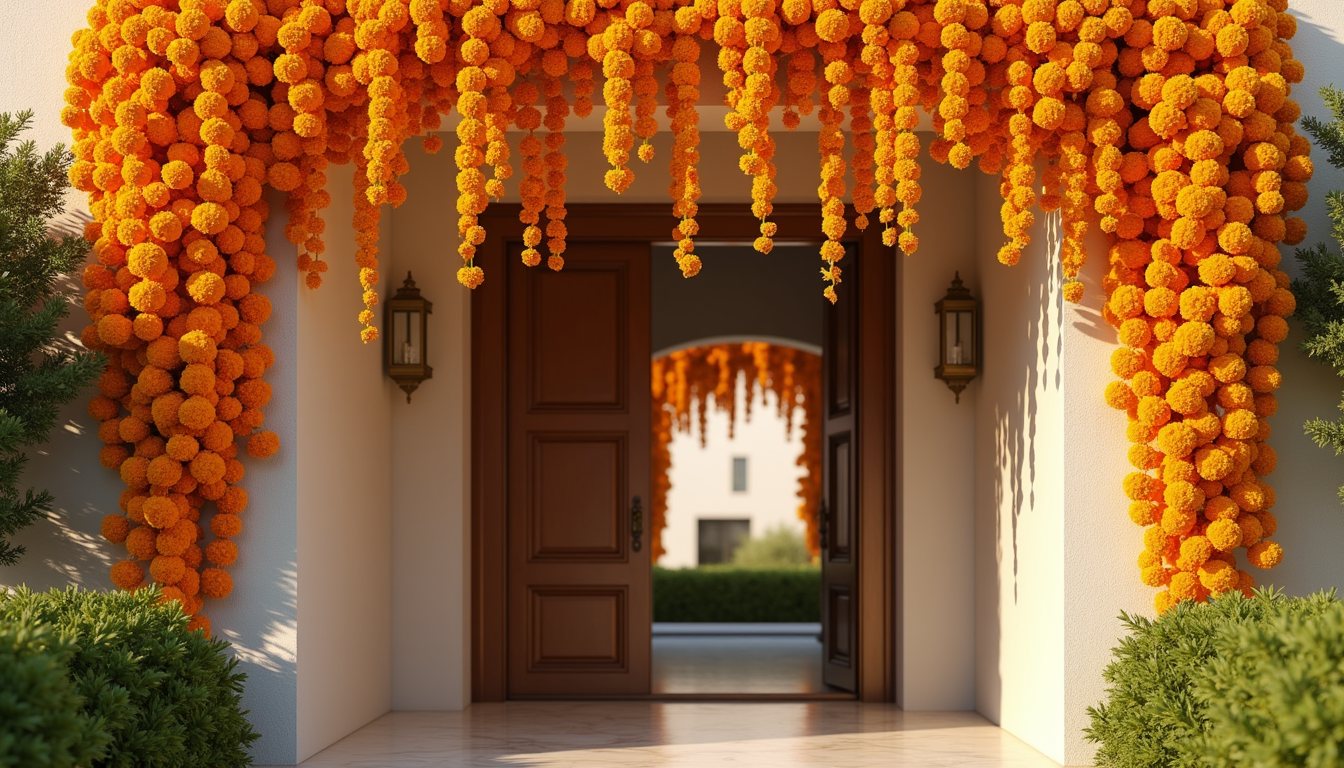
The toran. The doorway garland is the most visible use in Dubai. Strung fresh above the entrance, it marks the home as ready to receive guests and good fortune. During Diwali week you will see them across villa communities from Jumeirah to Al Barsha, replaced every couple of days as they dry.
Diwali and rangoli. Loose marigold heads and petals are worked into rangoli patterns at the entrance, often alongside diyas. The flower's density means a handful of heads covers ground that would take a whole bunch of anything else. Diwali 2026 falls on Sunday 8 November, with the five-day festival running from Friday 6 November to Tuesday 10 November. The date moves each year because Lakshmi Puja is always set to the new moon of the Hindu month of Kartik, which lands between mid-October and mid-November.
The mandap and the jaimala. At weddings, marigolds are draped across the mandap structure and strung into the jaimala, the garlands the couple exchange. The exchange is a public moment of acceptance, and the garland is meant to be substantial enough to be seen from the back of the hall.
The haldi ceremony. Marigold appears again at the turmeric ceremony held before the wedding, where its yellow-gold tone matches the haldi paste itself. The colour continuity is deliberate.
These are distinct traditions with distinct rules, and they vary by region, community and family. Treat the above as the broad pattern rather than a fixed script.
Planning ahead for Diwali 2026
The festival runs 6 to 10 November this year, and the week before it is the busiest in the Dubai floral calendar. Our signature arrangements are built for gifting and hosting, with same-day delivery across the city.
Shop the Signature CollectionMarigolds Around the World
Outside South Asia, the marigold is most often a flower of mourning. The contradiction is real, and it is worth knowing before you send one.
In Mexico the marigold is cempasúchil, the flower of Día de Muertos. Petals are scattered in paths from the street to the family altar, the belief being that the colour and scent guide returning spirits home. It is called the flower of the dead, and the name is affectionate rather than grim.
In Victorian Britain, floriography assigned the marigold to grief, cruelty and jealousy. Sent in a bouquet, it was a pointed message. Traces of that reading still shape how the flower is received in parts of Europe, where it rarely appears in celebratory arrangements at all.
In Nepal, the marigold returns to its auspicious register during Tihar, where garlands are placed on family members, and on cows and dogs honoured during the festival.
One flower, three readings, none of them wrong. The marigold's meaning is decided almost entirely by who is receiving it. The chrysanthemum carries a similar cultural split, celebratory in Asia and funereal across much of Europe.
Do Marigolds Survive the Dubai Climate?
Marigolds handle heat better than almost any other cut flower, which is precisely why they became the ceremonial flower of hot climates. They will not wilt in an afternoon the way a peony or a hydrangea will. But Dubai presents a problem that a Delhi summer does not, and it is not the heat itself.
The real damage comes from the swing. A garland travels in a car boot at well over 40°C in the June to September stretch, then goes straight into a majlis chilled to 18°C. That shock does more harm in ten minutes than three hours of sun. Air conditioning is also aggressively drying, and a garland hung directly under a vent will crisp at the edges within a day.
What actually works:
- Keep garlands out of direct airflow. Hang them away from vents and away from the path of a standing fan.
- Mist, do not submerge. A light mist once or twice a day is enough. Soaking a strung garland encourages the thread to rot and the heads to brown at the base.
- Expect two to three days from a strung garland indoors. Longer in cooler months, shorter in high summer. Plan replacements for multi-day celebrations.
- Loose heads in shallow water last noticeably longer than the same flowers strung on thread.
- Refrigerate overnight for a next-day event. A cool, dark place works if you do not have the fridge space. Bring them out an hour before guests arrive so they are not going straight from cold to warm in front of everyone.
Be realistic about the ceiling. Marigolds are tough, not immortal, and in July they will not give you a week. If you need something that holds for longer in a Dubai apartment, a living plant gift is the more durable choice.
How to Style Marigolds in a Dubai Home
Marigolds are visually loud, so the styling job is usually about control rather than abundance. A little structure stops them tipping into festival-stall territory.

The doorway toran. A single fresh garland across the entrance, hung high enough to clear the door. It works in a villa entrance and in an apartment hallway. Keep it to one line rather than three unless you are going full festival.
Floating heads in a shallow bowl. Snip the heads off and float them in a wide brass or ceramic bowl of water. This is the single best marigold treatment for a modern Dubai interior, and it suits the indoor-outdoor living most homes here are built around. Add three or four tealights around the rim in the evening.
A low table runner. For a Diwali dinner, run loose heads down the centre of the table in a shallow line, no taller than a hand's width, so guests can see each other across it. Mix in a few diyas and nothing else.
Soften them with white. Marigold alone reads as ceremonial. Marigold with white lilies or cream roses reads as a designed arrangement you could put in a living room in March. This is how to use the flower outside a festival context, and our hand-tied bouquets take the same approach.
Single clusters in brass. Three or four stems in a small brass vessel, repeated along a console or a windowsill. Restrained, and it lets the colour do the work without overwhelming the room.
When to Send Marigolds (And When Not To)
Send marigolds when the occasion is celebratory and the recipient reads the flower as auspicious. Hold back when you are not certain how they will read it. That second point matters more in Dubai than almost anywhere else, because the same doorstep can receive it three different ways.
Send them for: Diwali, Navratri, Tihar, weddings and engagements, housewarmings, new business openings, and any threshold moment where the message is prosperity and fresh starts.
Be careful with: sympathy and condolence, where the meaning genuinely flips. For a South Asian family, marigolds at a funeral are appropriate and expected. For a European or Levantine family, they may read as strange or even pointed. If you do not know the household's background, ask, or default to white lilies, which are understood as respectful across nearly every community in the UAE.
The general rule: marigolds are a wonderful flower to send to someone whose traditions you know, and a risky one to send to someone whose traditions you are guessing at. When in doubt, our mixed bouquets carry the warmth without the specific cultural freight.
Frequently Asked Questions
What does the marigold flower symbolise?
The marigold symbolises devotion, prosperity, the sun and remembrance. In South Asian tradition it is auspicious and used for temple offerings, weddings and Diwali. In Mexico and Victorian Europe it symbolises grief and remembrance instead. The meaning depends heavily on the cultural context of the person receiving it.
Why are marigolds used in Indian weddings?
Marigolds are used in Indian weddings because they are auspicious, affordable in volume, and structurally suited to garlands. The dense head holds its shape when threaded, so mandap drapes and jaimala garlands stay looking sharp through a long ceremony. The gold-orange colour is also associated with Lakshmi and with prosperity for the new couple.
What is genda phool?
Genda phool is the Hindi name for the marigold flower. Genda means marigold and phool means flower. It refers to the same bloom used across Indian ritual life, from temple offerings to wedding garlands to Diwali door hangings. The phrase is widely recognised across North India and throughout the South Asian community in Dubai.
Are marigolds lucky?
Marigolds are considered lucky and auspicious across South Asian tradition, particularly in gold and deep orange shades. They are hung at doorways to invite prosperity into the home and offered at temples as a mark of devotion. That association does not carry over to European tradition, where the flower is linked to grief rather than good fortune.
How long do marigold garlands last in Dubai?
A fresh marigold garland typically lasts two to three days indoors in Dubai, longer in the cooler months and shorter in high summer. Keeping it away from direct air conditioning airflow and misting it lightly once or twice a day extends that. Loose heads floated in shallow water last noticeably longer than strung garlands.
What colour marigold is best for Diwali?
Deep orange and golden yellow are the traditional Diwali colours, both read as auspicious and both associated with Lakshmi. Most households use a mix of the two, either strung into doorway garlands or worked into rangoli patterns with diyas. Cream and maroon marigolds are better suited to reflective occasions than to festival use.

Flowers that arrive the same day, across Dubai
Whether you are marking Diwali, a wedding or an ordinary Tuesday, our arrangements are built fresh and delivered the same day across the city. Browse the full range and choose by occasion, colour or budget.
Order Same-Day Bouquets

Leave a comment
This site is protected by hCaptcha and the hCaptcha Privacy Policy and Terms of Service apply.