
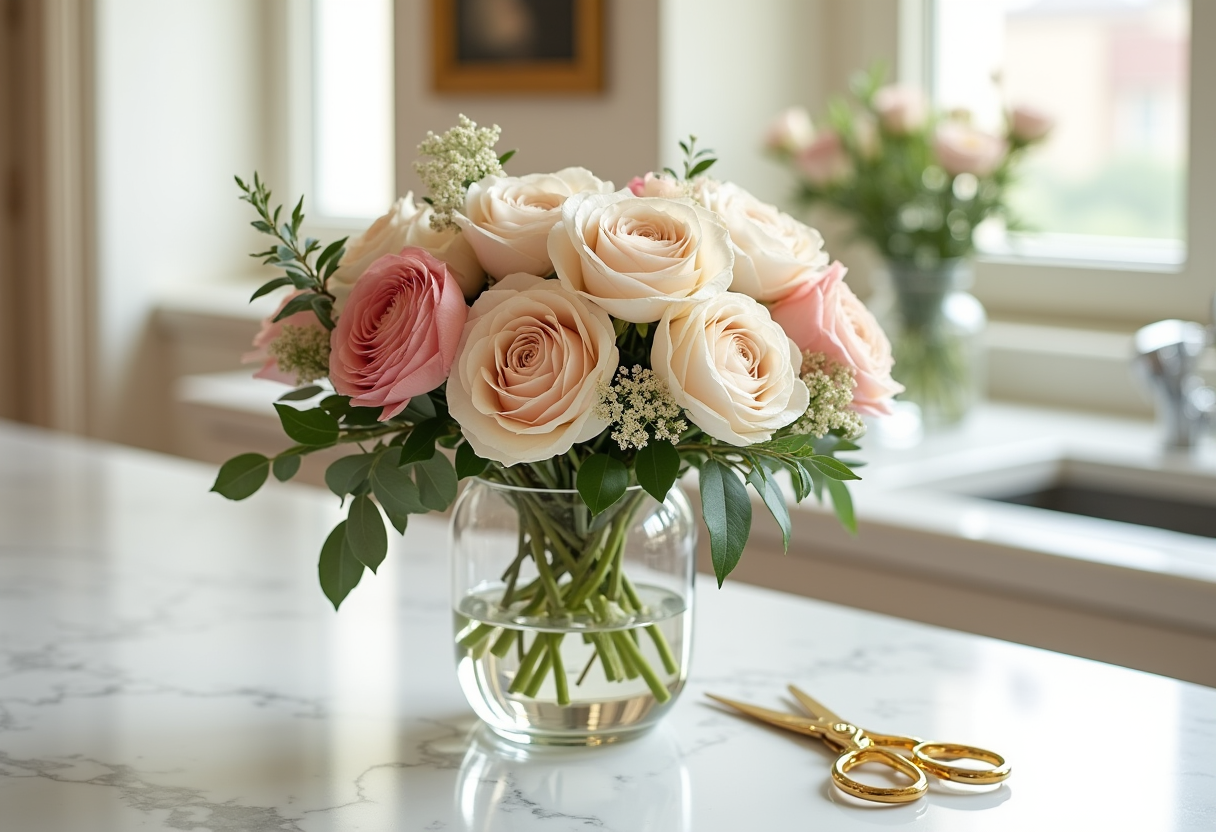
How to Arrange Flowers Like a Florist: A Dubai Expert's Step-by-Step Guide (2026)
There's a particular kind of disappointment that comes from buying a beautiful bunch of flowers, carrying them home, and watching them flop sideways in the vase within the hour. The blooms are lovely. The arrangement is not. The gap between the two is technique — and the good news is that technique is entirely learnable.
Upscale & Posh is Dubai's luxury flower delivery service, and our florists arrange thousands of stems every week. The methods they use aren't secrets. They're habits, repeated until they become second nature. This guide breaks those habits down into steps you can follow at your own kitchen counter, with tools you already own, in the specific conditions a Dubai home throws at fresh flowers.
By the end you'll know how to condition stems so they actually drink, how to build structure so nothing collapses, the five classic shapes every florist works from, and how to keep the finished arrangement alive far longer than the supermarket bunch ever managed — even at the height of a 45°C summer.
What you need: the florist's toolkit
You can arrange flowers beautifully with five basic tools, and you almost certainly own most of them already. A studio isn't required. A little kit is.
- Sharp scissors or secateurs. Blunt kitchen scissors crush the stem and seal off the very channels a flower drinks through. A clean, sharp snip is the single most important thing you can do for vase life. Floral snips are inexpensive; sharp household scissors will do for soft stems.
- A clean vase. Bacteria are the enemy of cut flowers, and a vase that "looks fine" often isn't. Wash it in hot, soapy water — a drop of bleach for anything that held flowers before — and rinse well.
- Flower food. That little sachet is not a gimmick. It combines sugar to feed the bloom, an acidifier to help water travel up the stem, and a biocide to slow bacteria. If you've lost it, a teaspoon of sugar plus a few drops of bleach per litre is a passable substitute.
- Room-temperature water. Most flowers drink best from cool, room-temperature water. (Bulb flowers like tulips and hyacinths are the exception — they prefer it cold.)
- Something to build a grid. Optional, but transformative: a roll of clear floral tape, a pin frog (the Japanese kenzan), or a loose ball of chicken wire. Any of these gives every stem a fixed place to sit instead of sliding into a clump.
One Dubai-specific note: cleanliness matters more here than almost anywhere. Heat accelerates bacterial growth in vase water, so a spotless vessel and fresh water do more for your flowers in this climate than any clever trick.

Condition your flowers first — the step almost everyone skips
Conditioning is the process of preparing stems to drink, and skipping it is the number-one reason home arrangements wilt early. It takes ten minutes of effort and a couple of hours of patience, and it is the difference between flowers that last three days and flowers that last ten.
- Unwrap and let them breathe. Take the flowers out of their wrapping straight away. Cellophane traps heat and humidity, and after a Dubai delivery run, your blooms want air.
- Strip the lower leaves. Remove any foliage that would sit below the waterline. Submerged leaves rot, feed bacteria and turn your water cloudy within a day.
- Cut every stem at a 45-degree angle. The diagonal cut increases the surface area that draws up water and stops the stem sitting flat on the bottom of the vase, where it would seal shut. Cut a good 2–3 cm off — the ends have already begun to callus over.
- Give them a long drink. Stand the freshly cut stems in clean, cool water for at least an hour before you arrange anything — ideally two or three. Florists call this letting them "have a drink up," and it's why a properly conditioned bouquet feels firm and lifts its head.
- Remove the guard petals on roses. The slightly bruised outer petals are there to protect the bloom in transit. Peel away one or two and the rose opens fuller and cleaner.

A word on Dubai water: the tap supply is desalinated and often runs warm, especially in summer. Let it run until it's cool, or use filtered water, and never start an arrangement with warm water straight from the tap — it shocks the stems and shortens their life.
The six-step florist method
Professional florists build almost every arrangement in the same order: structure first, focal flowers second, everything else last. Follow this sequence and a clumsy fistful of stems becomes a composed arrangement.
- Build a grid. Criss-cross clear floral tape across the mouth of the vase to make a lattice of small squares, or press a loose ball of chicken wire inside. Each opening holds a stem at the angle you place it — this is the invisible skeleton behind every arrangement that "just sits right."
- Lay the foliage base. Greenery goes in first. Eucalyptus, ruscus or Italian pittosporum create the outline and hide the mechanics. Work around the vase so the foliage spills slightly over the rim — flowers that sit too high on bare stems look stranded.
- Place your focal flowers. These are the stars — roses, peonies, hydrangea, large blooms that draw the eye. Two design rules earn their keep here: work in odd numbers (three, five, seven), which the eye reads as more natural than even groupings; and cut focal stems to roughly 1.5 times the height of the vase for classic proportion.
- Add secondary flowers. Slightly smaller blooms — lisianthus, ranunculus, spray roses — fill the spaces between the focal flowers and stop the arrangement looking like spotlights with gaps between them.
- Add texture and filler. The supporting cast brings movement: gypsophila (baby's breath), wax flower, astilbe or astrantia. Let a few stems sit higher than the rest so the arrangement breathes rather than forming a tight, flat dome.
- Turn, assess and finish. Rotate the vase as you work so it looks considered from every side, not just the front. Then step back, look at the silhouette, fill any obvious gaps and trim any single stem standing awkwardly proud.
The spiral technique for hand-tied bouquets
If you'd rather build a bouquet in your hand than in a vase, the secret is the spiral. Hold your first stems loosely and add each new one at the same slight angle, rotating the whole bunch a quarter-turn after every few stems. The stems cross in one consistent direction and fan out into a dome that stands up on its own when you set it down. It feels awkward for the first dozen stems and obvious by the fiftieth — it's exactly how our hand-tied bouquets get their full, rounded finish.

Five classic arrangement styles to know
Almost every floral arrangement is a variation on one of five classic shapes. Learn to recognise them and you'll always know where a stem belongs — and which shape suits the spot you're styling.
- Round (dome): The everyday classic — blooms massed into a soft, even dome that looks good from every angle. Ideal for a hand-tied bouquet or a coffee-table vase.
- Vertical: Tall and linear, drawing the eye upward. Perfect for a narrow console, an entryway or anywhere you want height without width.
- Horizontal: Long and low, the classic dinner-table centrepiece. The golden rule: keep it below eye level so guests can actually see and talk over it.
- Triangular: A symmetrical pyramid — tallest in the centre, tapering to the sides. Formal, balanced and the most forgiving shape for beginners.
- Crescent (S-curve): The show-off shape, also called the Hogarth curve. Two flowing arcs that demand a few sculptural stems and a confident hand — beautiful, and worth working up to.
There's a sixth worth knowing: ikebana, the Japanese art of minimalist arrangement, where a handful of stems and a great deal of negative space say more than a hundred blooms. It's a discipline in restraint, and a lovely antidote to the abundance of a Dubai gifting bouquet.
Short on time, high on standards?
Our florists do all of this for you — conditioned, arranged and delivered across Dubai the same day.
Arranging for a Dubai home
Dubai's climate is uniquely hard on cut flowers, so where you place an arrangement matters almost as much as how you build it. The two great enemies are heat and dry air — and most homes here run both at once.
Air conditioning keeps us comfortable but pulls moisture out of everything, flowers included. Direct sun through a window, meanwhile, can cook a bouquet in an afternoon. Keep your arrangements away from AC vents, off sunlit sills, and clear of the warm pocket of air that sits above televisions and routers. The coolest, shadiest spot in the room is almost always the kindest.
It also pays to match the shape to the spot:
- Entryway: Go tall and structural — a vertical or triangular arrangement makes a statement the moment someone walks in.
- Dining table: Stay low and horizontal. A centrepiece that blocks sightlines kills conversation; one that sits below eye level lifts the whole table.
- Bedside or desk: Keep it small and uncomplicated, and go easy on heavily scented blooms in a closed, air-conditioned room.
In the hottest months, build around blooms that genuinely cope with the heat — roses, orchids, anthuriums and chrysanthemums hold far better than delicate peonies, which can blow open and fade within a day. Our guide to the best summer flowers for Dubai's heat goes deeper on which varieties to choose between June and September.

How to make your arrangement last longer
With the right aftercare, a quality arrangement should last between five and ten days in a Dubai home — sometimes longer for hardy varieties. The flowers do most of the work; you just need to keep the conditions in their favour.
- Change the water every two days. In high summer, daily isn't excessive. Cloudy water is bacteria, and bacteria block the stems.
- Recut the stems each time. A fresh 45-degree cut of a centimetre or so reopens the channels every time you change the water.
- Keep it cool. Move the arrangement to the coolest room overnight, or even into the fridge before a special occasion, to slow the blooms down and buy yourself an extra day or two.
- Top up the flower food. Add a little more when you refresh the water, and your flowers keep feeding.
- Mind the fruit bowl. Ripening fruit gives off ethylene gas, which ages flowers fast. Keep arrangements well away from it.
- Pull spent blooms. The moment one flower dies, remove it — left in place, it releases more ethylene and drags the rest down with it.
If a bouquet does start to droop before its time, don't write it off. Our step-by-step guide to reviving wilting flowers can often bring tired stems back to life.
When to leave it to the florist
Arranging at home is genuinely satisfying, and for everyday flowers it's well worth doing. But some moments call for a florist's hand — a milestone that needs to feel considered, a gift that has to land perfectly, a dinner where you simply don't have the evening to spare.
That's where a designed arrangement earns its place. Our vase arrangements arrive conditioned, composed and ready to set down — no kit, no clean-up. For gifting, our luxury rose bouquets and the florist-designed Signature Collection carry the same techniques in this guide, executed by hands that do it thousands of times a week. Same-day delivery covers Dubai, so the flowers arrive as fresh as they left the studio.
Frequently asked questions
What are the main types of flower arrangement?
The five classic arrangement shapes are round (a soft, all-round dome), vertical (tall and linear), horizontal (low and wide, ideal for dining tables), triangular (a symmetrical pyramid) and crescent (a flowing S-curve, also called the Hogarth curve). A sixth, ikebana, is the Japanese minimalist style built around negative space. Most real-world arrangements are a variation on one of these.
How many flowers do I need for an arrangement?
For a small vase, 5–9 stems work well; for a generous table centrepiece, 15–25. The key design rule is to work in odd numbers of focal flowers — three, five or seven — because the eye reads odd groupings as more natural and balanced than even ones. Fill between the focal blooms with foliage and smaller filler flowers rather than simply adding more large stems.
How do you arrange flowers in a vase step by step?
Build a tape or chicken-wire grid across the vase mouth, add foliage first to create the outline, place your focal flowers in odd numbers at about 1.5 times the vase height, fill the gaps with secondary blooms, add filler for texture, then turn the vase to check it from every angle and trim any stem standing too proud.
What flowers last longest in Dubai's heat?
Roses, orchids, anthuriums, chrysanthemums and carnations are among the most heat-tolerant cut flowers and hold up best in Dubai's climate. Keep any arrangement away from direct sun and air-conditioning vents, change the water every two days, and expect a vase life of roughly five to ten days for these hardier varieties.
Do I need floral foam to arrange flowers?
No — and many florists now avoid it, as traditional floral foam is a single-use microplastic that doesn't biodegrade. A criss-cross grid of clear floral tape across the vase mouth, a reusable pin frog (kenzan) or a ball of chicken wire all hold stems just as securely and let the flowers drink from clean water, which is better for vase life anyway.
Let us arrange it for you
Florist-designed, conditioned and delivered the same day across Dubai.
Explore Our BouquetsWritten by the Upscale & Posh florist team, Dubai. Last updated June 2026.

Leave a comment
This site is protected by hCaptcha and the hCaptcha Privacy Policy and Terms of Service apply.