
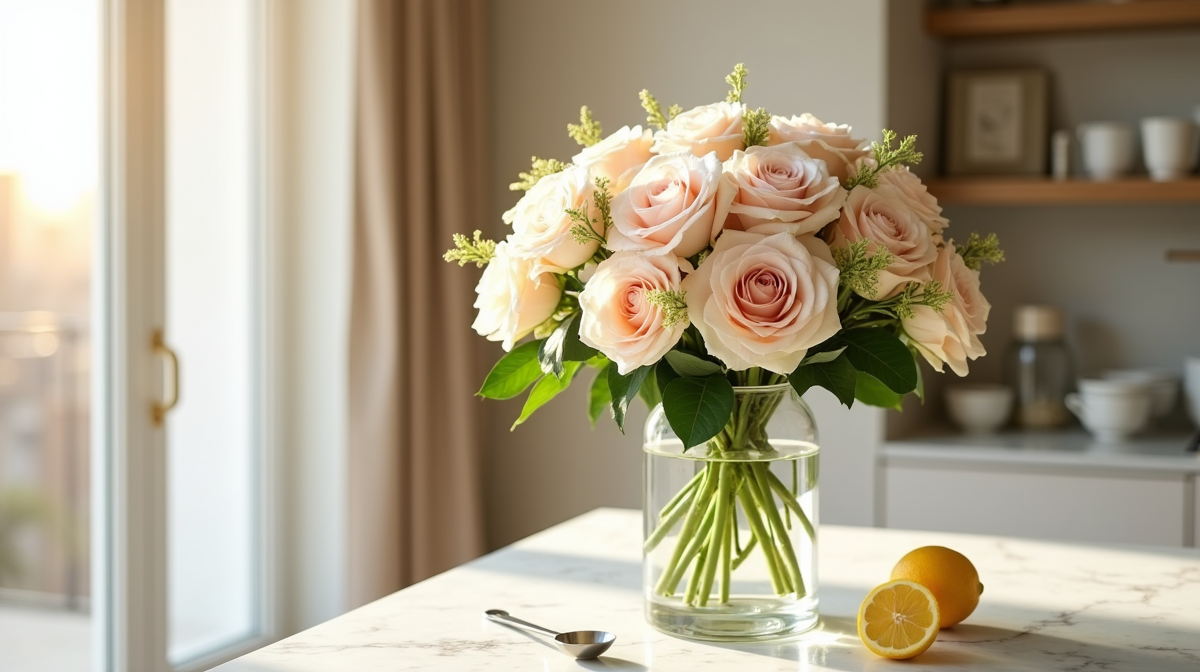
Homemade Flower Food: The Florist's Recipe That Actually Works

Your bouquet looked incredible on day one and half-dead by day four. That's not bad luck, it's untreated water. Homemade flower food is a simple mix of sugar, an acid, and a mild antibacterial agent stirred into the vase water, and it works because it feeds the stems, keeps the water clear of the bacteria that clog them, and helps the flowers draw water up efficiently. Get that balance right and most bouquets will hold their colour and structure for noticeably longer than they would in plain tap water.
Upscale & Posh is Dubai's luxury flower delivery service, and we get asked about this more than almost anything else. People assume a wilting bouquet means the flowers were tired to start with. Usually it just means the water wasn't doing its job. The good news is you don't need the little sachet that comes with a supermarket bunch. You need a teaspoon, a lemon, and two minutes.
What Does Flower Food Actually Do?
Every proper flower food, homemade or commercial, does three jobs at once. Miss one and the other two can't compensate.
Why do cut flowers need sugar in the water?
A cut stem is severed from its energy source, the leaves and roots that used to feed it. Sugar in the vase water replaces that lost supply, giving the bloom fuel to keep opening, colouring, and standing upright. Too little and the flower runs out of steam early. Too much and you feed the bacteria as well as the flower, which brings us to the second job.
Why does flower food include an acidifier?
Tap water is usually close to neutral or slightly alkaline. Cut stems draw water more efficiently through a slightly acidic solution, because it's closer to the conditions the plant's vascular system is built for. A splash of citric acid, whether lemon juice or white vinegar, lowers the pH just enough to keep water moving up the stem instead of stalling at the base.
Why does flower food need a biocide?
This is the part most people skip, and it's the reason flowers droop even when you remember the sugar. Bacteria multiply fast in still, sugary water, and they physically block the tiny xylem vessels that carry water up the stem. Once those vessels are clogged, no amount of fresh water fixes it. The flower is cut off from its own water supply from the inside out. A few drops of household bleach keeps the bacterial count low enough that the stem stays clear.
Get all three right and you're doing essentially what a professional floral preservative does. If you'd rather see what that looks like already put together, our full range of bouquets is prepped with this exact logic in mind before it ever leaves the studio.

The Recipe: Homemade Flower Food That Works
Here's the primary recipe, plus two variations for specific situations.
The Recipe
All-Purpose Homemade Flower Food
Makes enough for one standard vase — all measurements per 1 litre of water.
- Fill your vase with 1 litre of lukewarm water — not cold, not hot.
- Add 2 tablespoons (30ml) of fresh lemon juice or white vinegar as the acidifier.
- Add 1 tablespoon (15g) of granulated sugar.
- Add ¼ teaspoon (roughly 2–3 drops) of unscented household bleach as the biocide.
- Stir until the sugar has fully dissolved before you add the stems.
- Use it fresh — don't make it in advance and leave it sitting for days.
Variation 1: for tulips and other stems that keep growing
Tulips and similar stems are more sensitive to excess sugar, which can leave them soft and floppy in a warm room. Halve the sugar to 1 teaspoon (5g) and keep the lemon juice and bleach the same. Worth knowing if you've got tulips on the table.
Variation 2: bleach-free, using hydrogen peroxide
If you'd rather not use bleach, swap it for 1 teaspoon of 3% hydrogen peroxide, the standard chemist-bought strength. It plays a similar antibacterial role and releases a small amount of oxygen into the water as a bonus. Keep the sugar and lemon juice as per the primary recipe.
Change the water and remake the solution every two to three days, or sooner if it starts to look cloudy.

What NOT to Put in the Vase
The internet is full of vase folklore. Some of it has a grain of truth. Most of it doesn't.
- Aspirin. The theory is that aspirin acidifies the water the way citric acid does. In practice the dose in one tablet is too small to meaningfully shift the pH of a litre of water, and it does nothing about bacteria or sugar. Skip it.
- Copper coins. Old pennies had enough copper to act as a mild antibacterial agent, which is where this one comes from. Modern coins are mostly zinc or steel with a thin copper coating, so they release nowhere near enough to matter. Harmless, but pointless.
- Vodka or gin. A tiny amount of alcohol can slightly slow the enzyme activity behind ageing, so this has partial merit. But "tiny" is the operative word. A generous splash dehydrates the bloom faster than it helps, and it does nothing for bacteria.
- Lemon-lime soda. Closer to working than most myths, because regular (not diet) soda brings both sugar and acid. What it lacks is a biocide, so on its own it feeds bacteria as fast as it feeds the flower. Diluted soda with a few drops of bleach is a workable emergency fix. Soda by itself isn't.
- Sugar on its own. This is the one that actively backfires. Sugar without an acidifier and a biocide just accelerates bacterial growth, and a bouquet in sugar-only water will often go over faster than one in plain tap water.
- Too much bleach. A few drops is a biocide. A generous glug is a stem-damaging chemical. More is not better here.
How to Cut Flower Stems the Right Way
Preparation matters as much as the water itself.
- Cut at a 45-degree angle. An angled cut increases the surface through which the stem can draw water, and stops the end sitting flat against the base of the vase where it can't absorb anything.
- Cut underwater if you can. Submerge the stem end in a bowl of water and make the cut there. This stops an air bubble forming at the cut point, and air embolisms block uptake just as effectively as bacteria do.
- Strip any foliage below the waterline. Submerged leaves rot fast and are one of the biggest sources of bacteria in a vase.
- Use sharp, clean snips. Blunt blades crush the stem rather than cut it, damaging the very vessels you're trying to keep open.
- Re-cut every two to three days. Take about 2cm off the base each time you change the water, same angle, same technique. This clears bacterial build-up at the cut end and reopens fresh vessels.
That last habit is the single most common thing people skip, and it's why a bouquet that looked fine on day two can look tired by day five even with flower food in the water.

Flowers worth the effort
Every arrangement leaves our Dubai studio conditioned, hydrated and cut properly, so the care routine above starts from the best possible position.
Shop the Signature CollectionHow to Store Flowers to Make Them Last
Where a bouquet sits matters almost as much as what's in the water.
Overnight cooling helps enormously. Keeping flowers somewhere cool overnight, not necessarily the fridge, just a cooler room away from heat sources, slows the ageing process. If you do use a fridge, keep them well away from fruit. Ripening fruit releases ethylene gas, which speeds up wilting and petal drop in almost every flower type.
Keep them out of direct sun and away from heat. A warm windowsill or a spot near an oven will shorten vase life fast, no matter how good the water is.
Transporting a bouquet? Keep it upright where possible. If it has to lie flat, keep the trip short and re-cut the stems as soon as you arrive.
If a delivery arrives while you're out, leave it in its original wrapping and water sleeve somewhere shaded and cool rather than in direct sun on a doorstep. As soon as you're home, unwrap it, re-cut the stems, and get it into fresh flower food. Every hour spent dry outside a vase costs vase life later. If you'd rather skip a step entirely, our bouquets that arrive with their own vase take one job off the list on delivery day.
Caring for Flowers in Dubai: What Actually Changes
Dubai's climate and infrastructure shift the maths slightly, and it's worth knowing why.
Air conditioning is dehydrating. Most homes here run AC close to year-round, and that constant dry, cool air pulls moisture out of petals and foliage faster than a naturally humid room would. Keep bouquets away from direct vents and airflow. A flower blasted by cold, dry air all day will dehydrate even with perfect water.
Tap water here is largely desalinated. UAE municipal water tends to run alkaline and harder than the water most flower-food guidance is written for elsewhere, which is exactly why the acidifier step matters more here, not less. Don't skip it.
Summer heat is extreme. With temperatures regularly over 40°C, flowers near a window, on a sun-exposed balcony, or in a car for more than a few minutes will suffer fast. Glass intensifies heat even when the room itself feels air-conditioned, so check whether a spot gets direct sun during the day before you put a vase there.
In practice: change the water every one to two days rather than every three through summer, keep bouquets away from both direct sun and direct AC airflow, and if you're placing flowers on a balcony, bring them inside during the hottest part of the day.

Flower-by-Flower Notes
Roses. Keeping roses alive comes down to the recut habit more than anything else. Roses are especially prone to stem blockage, so recut every two days without fail and strip every submerged thorn and leaf. Our rose collection responds particularly well to the primary recipe.
Tulips. They keep growing and bending toward light even after cutting, so use the reduced-sugar variation and expect some natural curve. It's not a sign anything's wrong.
Lilies. Remove the orange pollen stamens as soon as the buds open. It stains fabric and petals badly, and taking it out extends the bloom slightly. Our lily collection needs no adjustment to the standard recipe.
Orchids. Cut orchid stems generally prefer plain water changed every few days over a sugar-heavy mix, and they're far more sensitive to cold draughts than to heat. Worth knowing if you're looking at our orchid range for a consistently air-conditioned room.
Hydrangeas. They drink through both the stem and the petals, so mist the heads occasionally alongside the usual vase care. Don't be alarmed if they wilt then recover after a deep drink. That's normal for this stem type, not a sign of decline.
Frequently Asked Questions
Does homemade flower food actually work?
Yes. When it includes all three elements — sugar, an acidifier and a mild biocide — it does the same job as a commercial floral preservative sachet. The most common reason a homemade version fails is missing the biocide step, since sugar alone in water accelerates bacterial growth rather than slowing decline.
How often should I change the water in a vase?
Every two to three days, remaking the flower food solution fresh each time rather than topping up old water. In a hot climate or through the Dubai summer, change it every one to two days, since heat speeds up bacterial growth in standing water.
Can I just use sugar water for cut flowers?
No. Sugar alone feeds bacteria as readily as it feeds the flower, and without an acidifier or biocide it can shorten vase life rather than extend it. Always pair sugar with an acid like lemon juice and a mild biocide such as diluted bleach.
Is aspirin good for flowers in water?
Not meaningfully. A single aspirin tablet doesn't contain enough acid to noticeably change the pH of a litre of water, and it does nothing to control bacteria, so it isn't an effective substitute for a proper acidifier or biocide.
How do I keep roses alive the longest?
Recut the stems every two to three days at a 45-degree angle, strip any foliage sitting below the waterline, and keep them in fresh flower food away from direct sun and heat. Roses are particularly prone to stem blockage, so the recutting habit matters more for roses than almost any other flower.
Do cut flowers need to go in the fridge overnight?
Not necessarily, but a cool room overnight does slow the ageing process noticeably. If you do use a fridge, keep the flowers well away from fruit, since ripening fruit releases ethylene gas that speeds up wilting.
None of this needs more than a lemon, a teaspoon, and a bit of consistency. Get the water right, recut the stems, keep the bouquet somewhere sensible, and a Dubai summer stops being the enemy it usually gets blamed for. If you want the fuller version of this routine, our guide to keeping cut flowers fresh in Dubai and our vase guide cover the rest.
Start with better flowers
Same-day delivery across Dubai, arranged the morning they go out. The care routine works best on stems that were fresh to begin with.
Shop All Bouquets


Leave a comment
This site is protected by hCaptcha and the hCaptcha Privacy Policy and Terms of Service apply.