
Sustainable Flowers in Dubai: The Long-Lasting, Lower-Waste Buying Guide

"Sustainable flowers" gets used to sell almost anything in Dubai right now - a grocery-store bouquet wrapped in kraft paper, a florist's homepage banner, a delivery box with a leaf printed on the side. None of that tells you whether the flowers themselves are actually a better choice. Upscale & Posh is Dubai's luxury flower delivery service, and this guide is our honest answer to a question we hear more often every year: what does "sustainable" really mean when you're buying flowers in a city where summer temperatures pass 40 degrees Celsius before most people leave for work?
In our view, it comes down to three things - which flowers you choose, how they're packaged, and how they're handled between grower and doorstep. No single label covers all three. Here's how to judge each one before you place an order this July.
What Does "Sustainable Flowers" Actually Mean?
A sustainable flower purchase is one where the bloom's lifespan, its packaging, and its handling all create less waste than the default option, not one stamped with a vague eco-label. That's a more useful definition than it sounds, because it gives you three concrete things to check on any order: how long this arrangement will realistically last, what you'll do with the packaging once the flowers are out of it, and whether the bouquet has been handled in a way that protects it from wilting before it reaches you.
None of this requires a certification scheme. It requires asking your florist a few direct questions and knowing what to listen for in the answers. Watch for language that sounds specific but isn't. "Eco-friendly," "conscious," and "responsibly sourced" appear across the flower industry without a consistent standard behind them - unlike organic food labelling, cut flowers have no single certification that a Dubai buyer can rely on across every florist. That's not a reason to ignore the idea. It's a reason to ask what's actually being done differently, rather than taking the label at face value.
Seasonal Growing vs. Flown-In Blooms
Most cut flowers sold in Dubai travelled a long way before they reached a vase, and that's true across the industry, not just for one brand. The UAE's climate isn't suited to growing most classic cut-flower varieties - roses, peonies, ranunculus - at commercial scale, so a large share of the cut-flower supply arriving here is flown in from major growing regions such as East Africa, South America, and the Netherlands, the same regions that supply most of the world's cut flowers, well beyond the UAE.
That fact matters less on its own and more for what it changes about "choosing sustainably" in this market. Flown-in isn't automatically the villain of the story - a well-organised cold chain moving flowers from grower to hub to florist can be more efficient, stem for stem, than a small local grower without proper refrigeration. The lever that actually matters for a Dubai buyer has less to do with a flower's country of origin and more to do with what happens after it lands: how long it sits before use, whether it's handled at the right temperature, and whether it's ordered in a quantity that gets used rather than binned.
Seasonality still matters, even for flowers that are always flown in. A rose forced to bloom out of its natural growing season, in a heated greenhouse thousands of kilometres away, generally takes more energy and resources to produce than the same rose grown during its natural season and then flown to Dubai. That's a more useful sustainability question to ask a florist than "where was this grown" - ask instead whether what you're buying is in its natural growing season somewhere, even if that somewhere isn't the UAE.
Why Dubai's Heat Changes the Sustainability Math
In a market where peak summer means 40 degrees Celsius or higher and an almost entirely indoor lifestyle, the biggest sustainability risk to a bouquet isn't how far it travelled. It's the twenty minutes between a delivery van and your air-conditioned front door. Heat stress is cumulative and mostly invisible until the bouquet is already compromised, which is exactly why it deserves more attention here than it would in a temperate climate.
The Real Waste Driver Is the Cold Chain, Not the Flower
A rose that would happily hold for a week in Amsterdam can wilt in under three days in Dubai if it's spent any real time outside refrigeration or air conditioning during a July afternoon. When that happens, the waste that matters most to a local buyer isn't where the stem was grown. It's that a flower with five more days of life in it got thrown away on day two. Ask whether your delivery uses insulated packaging or refrigerated transport during summer months, and treat that answer as at least as important as anything printed on the box.
5 Ways to Choose Lower-Waste, Longer-Lasting Flowers
These are the choices that make the most measurable difference on a typical Dubai order, roughly in order of impact.
- Choose naturally long-lasting varieties first. Orchids, anthuriums, and many lilies hold their form for two to six weeks with basic care, compared with five to seven days for many classic cut bouquets - measured per day of enjoyment, that's a significant drop in waste. Our orchid collection is built around exactly this.
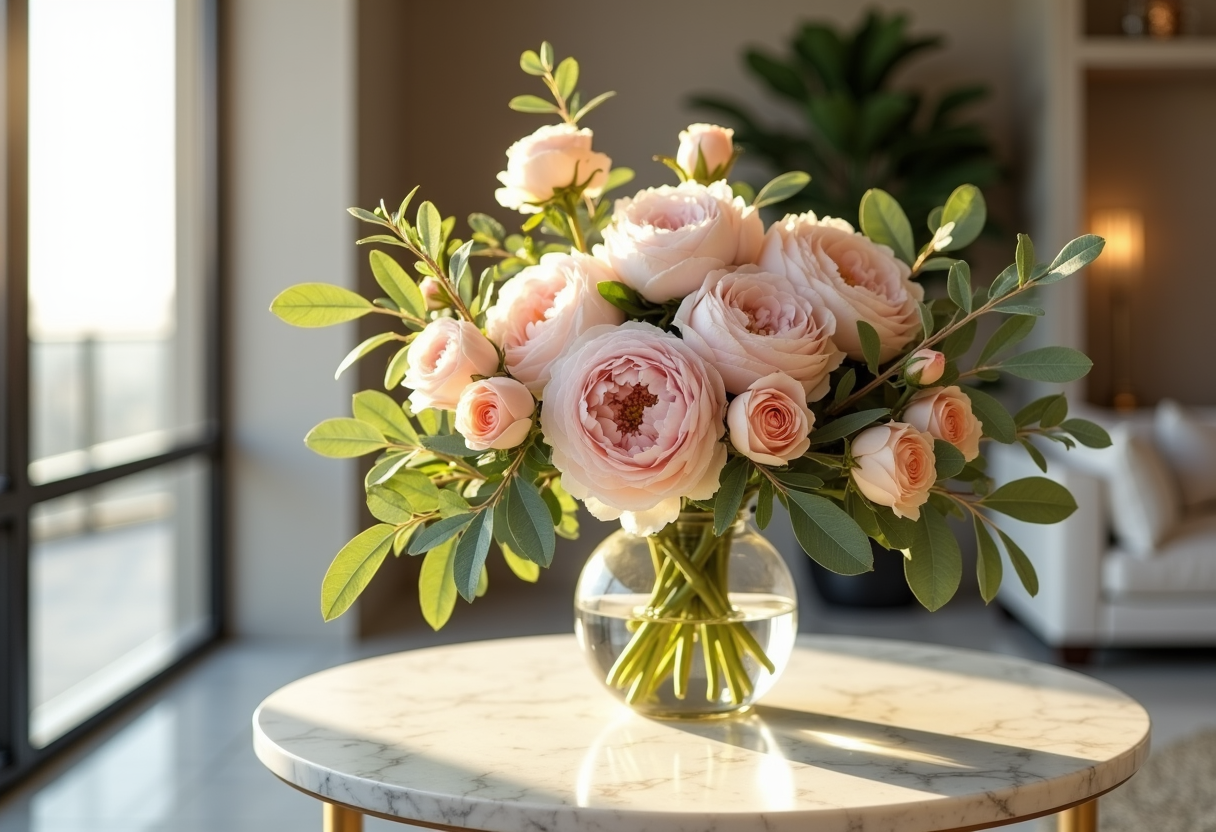
- Pick an arrangement that arrives in a keepsake vase. Skipping the separate "buy a vase too" step means one less piece of glass or ceramic purchased and eventually discarded. Look for vase arrangements designed to be reused for years, not binned along with the wrapping.
- Ask what the wrap is made of before you order. Paper, raffia, and minimal cellophane beat multiple layers of plastic sleeve and synthetic ribbon that go straight in the bin the same day they arrive.
- Time deliveries around the heat, not just your schedule. A bouquet delivered at 1pm in July sits in a hot vehicle and a hot doorway far longer, in relative terms, than one delivered at 9am or after 6pm. Ask your florist for a heat-safe slot between June and September.
- Order fewer, better stems instead of an oversized arrangement. A tightly composed dozen stems placed in water immediately and fully enjoyed beats an oversized bouquet where half the stems wilt in the box before anyone notices. Many of our best-selling arrangements are built on exactly this idea: considered, not oversized.

Questions Worth Asking Before You Order
A single question at checkout tells you more than any packaging graphic. These five take under a minute to ask and reveal whether a florist has actually thought about waste, or simply added the word "sustainable" to their site.
- Is this variety naturally long-lasting, or will it likely need replacing within a week?
- Does the arrangement include a vase I can keep and reuse, or will I need to buy one separately?
- What is the wrapping made from, and can it be recycled locally?
- How is this order protected from heat between dispatch and delivery in summer?
- Is this the right size for how it will actually be used, or is it oversized for the occasion?
Packaging: What to Actually Look For Before You Order
The most honest packaging question to ask any Dubai florist is simple: what happens to this box after the flowers come out? A cardboard box breaks down and recycles easily. A reusable glass or ceramic vase becomes a keepsake. A thick plastic sleeve or a block of soaked floral foam does neither, and both are still common in this market.
Three habits make a real difference here. Ask for paper-based wrap instead of plastic film when you order. Keep and reuse any vase you receive rather than replacing it next time - a good vase outlasts dozens of bouquets. And check before binning: some materials, especially plastic sleeves, aren't accepted in standard building recycling and need to go in general waste rather than the recycling bin, so tossing them in with paper doesn't actually help.
Vase materials matter here too. A heavy glass or ceramic vase is worth keeping regardless of the occasion - it's the kind of object that gets reused for a decade, not thrown out with the wrapping. Thin, decorative glass that's clearly designed for one use is a weaker choice even if it looks similar on delivery day, since it tends to end up in a cupboard once, then in the bin.

The Longest-Lasting Choices for Dubai's Summer
If lifespan is your main sustainability lever, three categories consistently outperform a standard mixed bouquet in Dubai's climate. Orchids tolerate indoor air conditioning well and can bloom for weeks with minimal care, which is why they're worth considering even for buyers who've never thought of themselves as "plant people." Potted arrangements go further still - a well-chosen piece from our plant gifts edit can last for years indoors rather than weeks, which is the lowest-waste gifting option available when the occasion allows for it. And for anyone who still wants the drama of a full arrangement, a vase-based design holds its structure and hydration far better through a Dubai summer than loose stems wrapped for a few hours before delivery.
Anthuriums and certain orchid varieties can outlast almost anything else in a Dubai apartment, often holding their shape and colour for a month or more indoors. Hydrangeas and lilies typically fall in the middle - often a week to ten days with the right care, longer than a standard mixed bouquet but shorter than an orchid. Knowing roughly where a flower sits on that scale before you order is the simplest way to match the gift to how long you actually want it to last.
Ready to Choose Something That Lasts?
Our orchid edit is built for exactly the buyer who wants fewer replacements and more weeks of bloom.
Shop the Orchid Edit
Practical Tips to Make Any Arrangement Last Longer at Home This Summer
Whatever you choose, how it's treated in the first 48 hours at home matters more in Dubai's heat than almost anywhere else. Five habits extend the life of nearly any arrangement.
- Keep arrangements away from direct air-conditioning blast - the constant dry air pulls moisture out of petals faster than still air does.
- Avoid windowsills and glass doors in direct sun; glass magnifies heat even with the AC running, and a spot that looks shaded in the morning can bake by 2pm.
- Change the water every two days instead of every four or five - bacteria builds up faster in a warm room, and cloudy water is usually the first sign a bouquet is about to turn.
- Re-cut stems at an angle after any car journey, even a short one; a hot car is one of the fastest ways to shock a fresh bouquet before it's even reached your table.
- Keep arrangements away from the fruit bowl - ripening fruit releases ethylene gas, which speeds up wilting in most cut flowers, and it's an easy fix once you know to separate them.
Frequently Asked Questions
What makes a flower "sustainable"?
A flower purchase is more sustainable when it creates less waste across three points: the bloom is a variety that lasts rather than wilting within days, the packaging is minimal and recyclable or reusable, and the delivery process avoids unnecessary heat exposure or over-ordering. There is no single certification that covers all three, so it comes down to the specific choices made on each order.
Are most flowers sold in Dubai flown in from abroad?
Yes. The UAE's climate is not suited to growing most classic cut-flower varieties, such as roses and peonies, at commercial scale, so the majority of cut flowers sold across Dubai are flown in from major growing regions including East Africa, South America, and the Netherlands. This is standard across the global cut-flower industry and is not specific to any one florist.
Do longer-lasting flowers cost more than a regular bouquet?
Not necessarily. Orchids and other long-lasting varieties are often priced comparably to classic bouquets, and because they stay fresh for two to six weeks rather than five to seven days, the cost per week of enjoyment is usually lower. The bigger price difference comes from arrangement size, not flower type.
What is the most sustainable flower to gift in Dubai's climate?
Orchids and potted plants are generally the lowest-waste choices for Dubai's climate, since both tolerate indoor air conditioning well and last for weeks or longer rather than days. If a cut-flower bouquet suits the occasion better, choosing a vase arrangement over loose stems avoids an extra single-use purchase.
How should I recycle or dispose of flower packaging in Dubai?
Separate the packaging by material before disposal: cardboard and paper wrap can go into most buildings' recycling stream, glass or ceramic vases are worth keeping and reusing, and plastic sleeves should be checked against local recycling guidance, since not all plastic film is accepted in standard recycling bins. When in doubt, reusing the vase is the simplest lower-waste step.
Choose a Bouquet Built to Be Kept, Not Binned
Our vase arrangements arrive ready to display and ready to reuse, long after the flowers are gone.
Shop Long-Lasting Vase ArrangementsNone of this requires overhauling how you buy flowers in Dubai. It requires asking better questions before you check out, about the variety, the wrap, and the journey, and choosing the option that turns out to be the more considered one, not just the one with "sustainable" printed on the box.

Leave a comment
This site is protected by hCaptcha and the hCaptcha Privacy Policy and Terms of Service apply.