


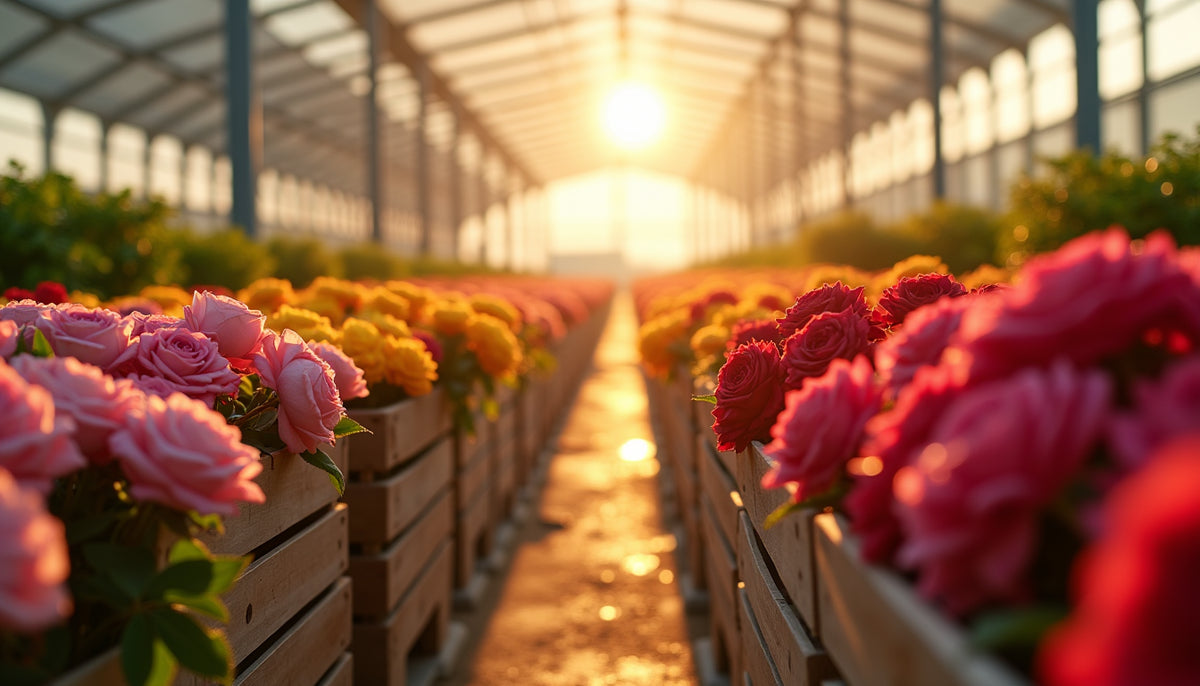
Where Do Dubai's Flowers Really Come From? A Flower Farm Dubai Sourcing Guide
If you've ever unwrapped a bouquet in Dubai and wondered how roses this fresh made it to a city surrounded by desert, you're asking the right question. Where do Dubai's flowers really come from — a genuine flower farm in Dubai, or a cold-chain journey from a greenhouse thousands of kilometres away? The honest answer is both, and knowing the difference changes how you think about freshness, sustainability, and what "local" really means when you buy flowers in this city.
Upscale & Posh is Dubai's luxury flower delivery service, and this is a question our customers ask often enough that it deserves a straight answer. Below, we walk through how flowers actually reach Dubai, what genuinely grows in the UAE's climate, and what sourcing decisions — yours and your florist's — mean for freshness, cost, and the planet.
Quick answer: Most of Dubai's cut flowers are imported, air-freighted from the Netherlands, Kenya, Ecuador, and India through logistics hubs like the Dubai Flower Centre at DWC. True outdoor flower farms are rare in the UAE's desert climate — local sourcing here usually means Gulf-grown greenhouse blooms, seasonal buying, and trusted regional growers, not a backyard farm.

Where Do Dubai's Flowers Really Come From?
Walk into almost any florist in Dubai and the flowers on the counter have likely travelled further than most of their customers do in a year. The global cut-flower trade runs on a small number of growing regions with the climate, labour, and infrastructure to produce flowers at scale, and Dubai sits at one of its busiest crossroads.
The Netherlands remains the trade's centre of gravity. Aalsmeer, near Amsterdam, is home to the world's largest flower auction, where millions of stems change hands daily before being distributed worldwide. Kenya and Ethiopia are among the largest exporters of roses, thanks to high-altitude, equatorial growing conditions that produce long stems and vivid colour with relatively low energy input. Ecuador is prized for oversized, long-lasting roses, Colombia for carnations and chrysanthemums, and India has grown into a significant exporter of roses and gladioli to Gulf markets.
None of these flowers reach Dubai by sea. Cut flowers are perishable in a way most cargo isn't, so the entire trade is built around speed: stems are cut, graded, and packed into refrigerated boxes, then flown — often within 24 to 48 hours of harvest — to distribution points near major cities. Dubai is one of the most important of those points in the world, not just for the UAE but for the wider Gulf, East Africa, and parts of Asia.
Dubai's Role as a Global Flower Trading Hub
Dubai's position between Europe, Africa, and Asia, combined with Dubai World Central (DWC) and Al Maktoum International Airport, has made it a natural transit and trading point for the flower industry. The Dubai Flower Centre, a dedicated cold-chain facility at DWC, handles imported stems around the clock — receiving, inspecting, cooling, and redistributing flowers that arrive from Kenya, Ethiopia, the Netherlands, Ecuador, and elsewhere.
A meaningful share of what lands in Dubai doesn't stay in Dubai. The city re-exports flowers onward to Saudi Arabia, the wider GCC, Russia, and parts of Central Asia, which is one reason the volumes moving through its flower facilities are so much larger than local retail demand alone would suggest. For Dubai's florists, this hub status is genuinely useful: it means faster customs clearance, better cold-chain handling, and more consistent stem quality than a city without this infrastructure could offer — even though almost none of it is grown within the UAE itself.
What Actually Grows in the UAE's Climate?
This is where most guides to Dubai's flower industry get vague, so let's be direct about it: the UAE's climate makes large-scale outdoor cut-flower farming genuinely difficult. Summer ground temperatures regularly pass 45°C, humidity swings are extreme near the coast, and the sandy, low-organic soil across most of the country isn't naturally suited to the delicate, water-hungry crops that the Netherlands or Kenya's highlands produce with ease. There is no UAE equivalent of Aalsmeer or the Kenyan rose belt, and it's worth being upfront about that rather than romanticising a flower farm in Dubai that doesn't really exist at scale.
What does exist is smaller and more specific. Protected cultivation — greenhouses with climate control, shading, and drip irrigation — allows a limited range of flowers that grow in the UAE to be produced locally and regionally, mostly for landscaping, hospitality, and government greening projects rather than the cut-flower trade. Some Gulf growers, particularly in Saudi Arabia, Oman, and parts of the UAE, do grow roses and ornamentals under cover for regional markets, and this regional production is the closest thing to "local" that most Dubai florists can realistically draw on.
5 Flowers That Genuinely Grow Well in the UAE Climate
- Bougainvillea — a mainstay of Dubai's gardens and roadside landscaping, thriving in heat and tolerating poor soil and drought once established.
- Desert Rose (Adenium) — a succulent flowering plant native to arid climates, right at home in UAE gardens and courtyards.
- Marigold — a reliable cool-season bloomer in the UAE's October-to-March growing window, widely used in parks and public planting.
- Oleander — heat- and salt-tolerant, common along Dubai's highways and in landscaped developments.
- Greenhouse-grown roses — not a desert-grown flower in the wild sense, but viable under protected cultivation with climate control, drip irrigation, and shading, which is how most regional rose production actually happens.
Notice what's missing: the delicate, long-stemmed varieties most people picture in a luxury bouquet — garden roses, peonies, ranunculus, lisianthus — simply don't grow reliably outdoors in this climate. That's not a failure of local agriculture; it's a basic mismatch between desert conditions and what those flowers need.
Seasonal Flowers in the UAE: Why Timing Still Matters
Even without large-scale local cut-flower farms, seasonality still shapes what's available and at what quality in Dubai. The UAE's mild winter, roughly November to March, is the closest thing the region has to a growing season for outdoor ornamentals, and it's also when regional greenhouse production tends to be at its most efficient, since cooling costs drop. Buying with that rhythm in mind, rather than insisting on the same bloom year-round, is one of the more practical ways to support better sourcing without sacrificing quality.
Roses remain available in Dubai throughout the year because they're grown under cover across multiple regions and climates, which smooths out seasonal gaps. Other varieties genuinely do have better and worse months, which is why a good florist will sometimes suggest a substitution rather than flying in an out-of-season stem at a premium — a small sign that sourcing, not just styling, is part of how they think.

Why Sourcing Distance Matters for Sustainability, Freshness & Cost
Every flower that travels from a farm to a Dubai doorstep carries a cost beyond the price tag — in carbon, in handling, and in the hours it spends outside a cold chain. Understanding that cost helps explain why sourcing distance isn't just a sustainability talking point; it directly affects how long your flowers last in the vase.
Air freight is carbon-intensive compared to almost any other way of moving goods, and flowers are also kept refrigerated at nearly every stage — in the farm's cold store, in transit, in the Dubai Flower Centre's facilities, and ideally in the final florist's shop — which adds an energy cost on top of the flight itself. It's worth noting that flowers grown in a naturally warm, sunny climate like Kenya's highlands and flown to market can, in some comparisons, have a lower total carbon footprint than flowers grown in heated European greenhouses during winter. Distance isn't the only variable, and a shorter flight from an energy-intensive greenhouse isn't automatically "greener" than a longer one from a naturally sunlit farm.
What distance reliably does affect is freshness. Every hour a stem spends between harvest and your vase is an hour off its usable life, and every break in the cold chain accelerates that clock. This is why the strength of the logistics — not just the country of origin — tends to matter most for how long your flowers actually last.
| Factor | Imported Flowers (Netherlands, Kenya, Ecuador, India) | Regionally-Grown Flowers (Gulf greenhouse) |
|---|---|---|
| Freshness on arrival | High if the cold chain stays unbroken, but typically 24–48+ hours old by the time they reach a shop | Often fresher at point of sale thanks to shorter transit |
| Variety available | Very wide — garden roses, peonies, ranunculus, exotic orchids | Narrow — mainly roses and a handful of hardy ornamentals |
| Typical cost | Higher, reflecting air freight, cold storage, and customs handling | Can be lower, but regional supply is limited and less consistent |
| Environmental footprint | Higher per-stem carbon cost from air freight and cold-chain energy | Lower transport footprint, though greenhouse cooling still uses energy |
| Availability year-round | Consistent, since growers are spread across hemispheres and seasons | More seasonal, tied to the UAE's cooler months |
What Ethical Sourcing Actually Means for a Dubai Florist
"Ethical sourcing" gets used loosely in the flower industry, so it's worth being specific about what it actually involves in practice, rather than treating it as a marketing label.
Grower relationships. Buying through the same farms and trading partners repeatedly, rather than purely on daily auction price, makes it easier for a florist to ask questions about labour conditions, water use, and pesticide practices — and to walk away from a supplier that won't answer them.
Certifications. The global flower trade has a few recognised certification schemes worth knowing as a buyer. Fairtrade sets standards for worker pay and conditions on certified farms, and the Rainforest Alliance certifies environmental and social practices on farms across Kenya, Ethiopia, Colombia, and Ecuador, among other origins. These aren't universal across the trade, and not every grower that meets high standards carries a formal certification, but they're a useful signal when you do see them.
Reducing floral foam and plastic waste. Traditional floral foam is a microplastic that doesn't biodegrade, and the industry has been shifting toward foam-free mechanics — chicken wire, reusable frogs, and foam-free design techniques — along with cutting back on single-use plastic sleeves and packaging.
Seasonal and regional buying. Choosing varieties that are in natural season, or that come from closer regional growers when quality allows, reduces reliance on the longest, most carbon-intensive supply chains without asking a customer to give up variety entirely.
At Upscale & Posh, we work with trusted growers and trading partners and prioritise freshness and responsible sourcing wherever we reasonably can — favouring suppliers who can speak clearly to how their flowers were grown and handled, rather than claiming a supply chain that doesn't exist for a city in the middle of the desert.

How to Choose More Sustainably Sourced Flowers in Dubai
None of this requires becoming an expert in global horticulture. A few direct questions and small choices go a long way.
Questions to Ask Your Florist About Sourcing
- Where were these flowers grown, and roughly how long ago were they cut?
- Do you buy through the same growers regularly, or purchase whatever is cheapest at auction that day?
- Do any of your suppliers carry Fairtrade or Rainforest Alliance certification?
- Is this arrangement built with floral foam, and is a foam-free version available?
- Which flowers in this bouquet are in natural season right now?
How to Spot Genuinely Seasonal or Regional Blooms
- Price is a tell — regionally-grown or in-season stems are usually priced more consistently, while flying in an out-of-season variety often comes at a premium.
- Ask directly rather than assuming. "Seasonal" and "local" get used loosely enough in marketing that a direct question is worth it.
- Expect a narrower palette. Genuine UAE and Gulf-region growing is largely limited to roses and a handful of hardy ornamentals, so an arrangement built entirely from regional stems will look noticeably different from one with imported peonies and ranunculus.
Simple Choices That Add Up
- Choose a Vase Arrangement over loose stems set in floral foam when freshness and foam-free presentation both matter to you — a well-maintained vase arrangement can outlast a foam-set piece.
- Ask for seasonal substitutions instead of insisting on one specific variety out of season.
- Reuse or recycle the vase, wrapping, and ribbon rather than discarding them after one arrangement.
- If orchids are part of your order, know that Orchids are almost always imported and grown under intensive protected cultivation — a luxury bloom with a genuinely long supply chain, worth choosing deliberately rather than by default.

Want flowers chosen with sourcing in mind, not just looks?
Frequently Asked Questions About Flower Sourcing in Dubai
Are there any real flower farms in Dubai or the UAE?
There isn't a flower farm in Dubai producing cut flowers at commercial scale the way the Netherlands or Kenya does. A small number of regional greenhouse growers across the Gulf produce roses and ornamentals under climate control, but the vast majority of cut flowers sold in Dubai are imported and air-freighted in.
Why are flowers in Dubai often imported instead of grown locally?
The UAE's extreme heat, high humidity swings, and sandy soil make large-scale outdoor cut-flower farming impractical compared with regions naturally suited to it, like Kenya's highlands or the Netherlands. Importing from established growing regions is more reliable and cost-effective than trying to replicate those conditions artificially at scale.
What is the Dubai Flower Centre?
The Dubai Flower Centre is a dedicated cold-chain facility at Dubai World Central (DWC) that receives, inspects, cools, and redistributes imported flowers. It's one of the reasons Dubai functions as a major flower trading hub for the wider Gulf region, not just for local retail demand.
Is importing flowers by air bad for the environment?
Air freight does carry a higher carbon cost than most transport methods, and flowers also require refrigeration at nearly every stage. That said, flowers grown in a naturally warm climate and flown to market can sometimes have a smaller total footprint than flowers grown in a heated greenhouse closer to home, so distance alone isn't the whole picture.
How can I tell if a Dubai florist sources flowers responsibly?
Ask direct questions: where the flowers were grown, whether the florist buys through consistent grower relationships, whether any suppliers carry certifications like Fairtrade or Rainforest Alliance, and whether foam-free arrangements are available. A florist who can answer specifically, rather than vaguely, is usually sourcing more thoughtfully.
Ready to send something genuinely fresh?
Dubai's flower trade will likely always lean on imports — the city's climate simply isn't built for large-scale cut-flower farming, and its real strength is as a world-class trading and logistics hub rather than a growing region. What you can control is how thoughtfully those flowers are chosen: asking where they came from, favouring seasonal and regional options when they suit the occasion, and choosing a florist who treats sourcing as part of the craft, not an afterthought.
Last updated October 2026.


Leave a comment
This site is protected by hCaptcha and the hCaptcha Privacy Policy and Terms of Service apply.